Posts

Showing posts with the label Reading

Game Stories

Image
Story telling in video games is a young art form that is increasingly rising. Successful story’s in games are designed by looking at what has worked in other story’s and making yours unique to other stories. Games aren’t movies and movies aren’t plays. To create a story in a game we have to first look at what attributes to a story that works with all platforms from movies to novels to plays etc. what is common between them all.   Conflict is storys. Story is conflict.   We can use a base structure when coming up with our game We start of with our hero or main character There is then an “inciting Incident” something that happens that strikes conflict. There is then an opportunity for our hero to push back against his conflict when he first tries and fails there are repercussions.  The hero now takes on a risk to overcome the obstacles that have resulted in this conflict this process is repeated twice with an even bigger risk the second time round and an even bigger risk th...

Week 9 Reading and Writing

Image
Reflection This weeks reading task was to look back over all our previous reading a writing assignment’s. Ill start off by saying this. I haven’t found the readings enjoyable just because its not an area I’m passionate about but I have found them bearable and useful. They’re not overly complicated so if you put the time in there’s no reason for me to complain.   I Personally haven’t had too many issues with the tasks. It definitely helps that there are 3 different articles covering the same topics. I found this helpful because the academic papers I find a very hard to digest. If all we had were the academic papers I would probably have no clue what were supposed to be learning over the semester. With that being said every week I go to attempt the academic paper they’re slowly becoming easier to digest.       I think the reading tasks definitely helped me when it comes to creating our games. Throughout the semester all the information we need to create a suc...

Game Fun

Image
Reading Week 8 “Game Fun" Games can be described by the 3 components Mechanics, Dynamics, and Aesthetics (MDA) or otherwise stated as rules – system – “fun” . The three reading selections this week and the synopsis below all address the term “fun” in relation to game design. There are eight types of Fun outlined by the MDA. These eight are both a source of reference and player experience that blend together in many ways, and essentially what makes a game engaging and enjoyable. Figure 1: Eight kinds of Fun Both Oxford and Merrian dictionaries define Fun as an enjoyment, delight but within the context of a game it refers to a form of pleasurable entertainment. MDA papers define the '8 kinds of fun' sensation, fantasy, narrative, challenge, fellowship, discovery, expression, and submission, remain a source of reference and possibly the most popular list of player interactions combining in various forms to attract each player to a particular game. Nicole Lazzaro presents fou...

Game Decisions

Image
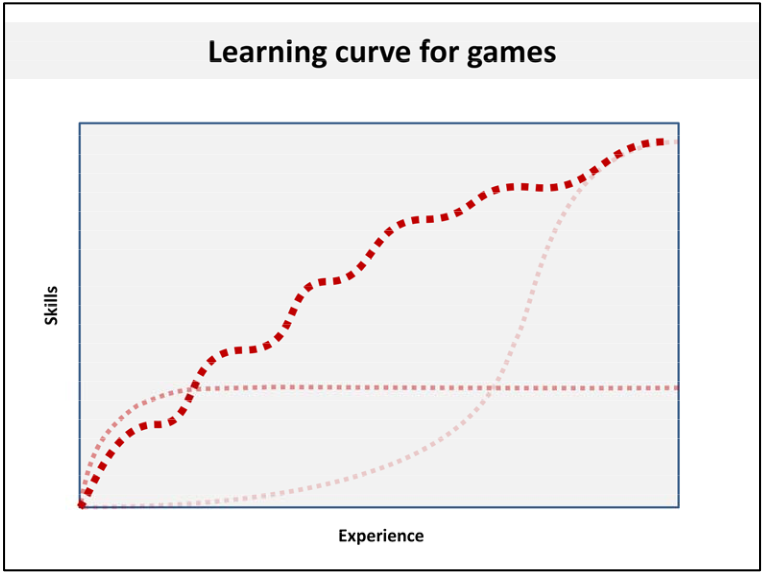
Video “In order for the player to be optimally engaged, challenges should be presented at a level equivalent or slightly higher than their current skill. Not too easy, not too hard”( Gigity McD ) The word 'flow state' was coined by Csikszentmihalyi (1975) also known as being “in the zone” This is when the player is fully engaged in the game experience. Csikszentmihalyi put a lot of work into observing and analyzing various groups of people. This theory is focused on the idea of how people should balance their skills and the demands of particular tasks. An example of Flow would be a challenge in a game that interests the player such as a puzzle or a boss battle meant to keep the player interested and not get bored. Csikszentmihalyi also states that flow is related to an ideal psychological condition when a person engages in a challenge-skill activity, often resulting in concentration and a focused emphasis on a task. A practical technique for improving Flow is to look at what p...